Partnership exhibit Allrounder 570A Medical - Fakuma 2026
Arburg, Kebo and Matriq will demonstrate the production of auto-injector housings with individual Data Matrix codes at Fakuma 2026. The codes are formed directly in the mould using 144 individually controlled microheaters.
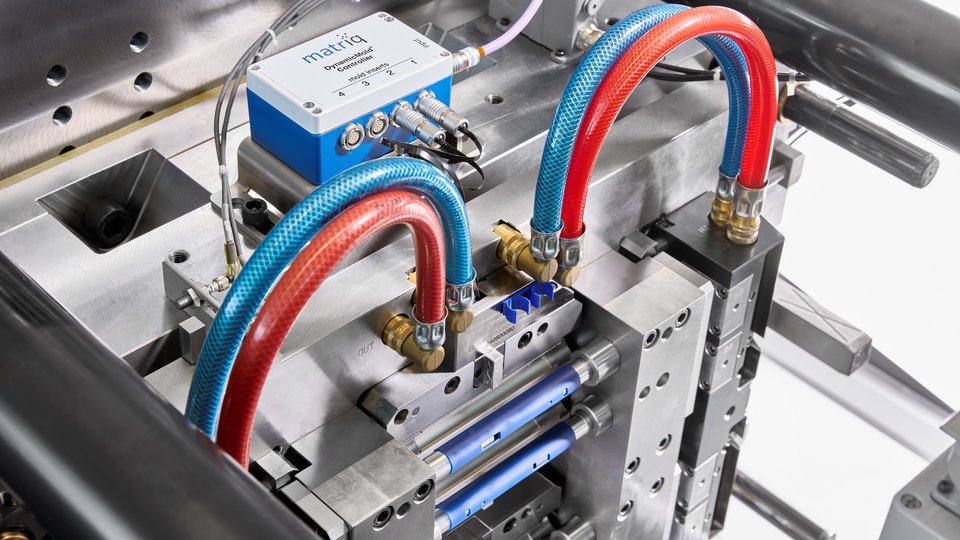
At Fakuma 2026, Arburg, Kebo and Matriq will demonstrate an in-mould marking process intended for medical technology applications. An electric Allrounder 570 A injection moulding machine in a cleanroom version, equipped with a four-cavity mould, will produce auto-injector housings with individual Data Matrix codes. The codes are formed directly on each component during injection moulding by a dynamic mould insert containing 144 heating elements, each measuring 0.28 x 0.28 millimetres. The process is suitable for a range of materials and eliminates separate downstream marking operations. According to the project partners, this can reduce energy consumption, cycle time, installation area and costs. The production cell will be presented at the Matriq stand in Hall A4, Stand 4213. Arburg will also display another medical technology production cell in Hall A3, Stand 3101. Kebo will be located in Hall B3, Stand 3313, while material supplier Borouge International will exhibit in Hall A4, Stand 4218.
Marking with microheaters in the mould insert
The electric Allrounder 570 A, with a clamping force of 2,000 kN, will produce four auto-injector housings in a cycle time of approximately eleven seconds. The cleanroom machine is designed to meet the requirements of production in an ISO Class 7 cleanroom. The housings will be moulded from Bormed HG820MO medical-grade polypropylene supplied by Borouge International and coloured blue with a colour masterbatch from Color Service.
The machine belongs to Arburg's Alldrive series. Its Gestica control system incorporates aXw Control PressurePilot, which uses bionically optimised pressure control to support consistent mould filling and part quality.
Kebo's four-cavity mould is based on the company's Lift & Strip concept. It is actuated entirely mechanically and synchronously by the machine ejector. According to the partners, this arrangement supports a robust and reproducible process, as well as the transition from pilot production to series manufacturing.
The dynamic insert integrated into the mould cavities assigns an individual Data Matrix code to every component. Its 144 microheaters can be controlled separately and reach the required temperature within milliseconds, creating individual geometric structures. Each heating element measures 0.28 x 0.28 millimetres and weighs approximately 1.5 micrograms, around 20,000 times less than a grain of rice.
As the marking is performed during moulding, no additional marking equipment or robotic handling system is required for a subsequent process step. This reduces the space required by the production cell and avoids the cycle time and costs associated with downstream marking.
Production data linked to each component
A central database communicates with the Gestica machine controller and the Matriq system through an OPC UA interface. An NTP server synchronises the system time. The part ID, relevant production and measurement data from the Allrounder, and the individual Data Matrix code are linked synchronously in the database.
A camera system can subsequently identify each component and assign it to the corresponding production and measurement records. Machine data and process parameters, including the date, shot count, injection pressure and material cushion, can therefore be retrieved for the individual housing.
100 per cent traceable: Thanks to microheaters embedded in the mould insert, each auto-injector housing contains a unique Data Matrix code derived from the original material
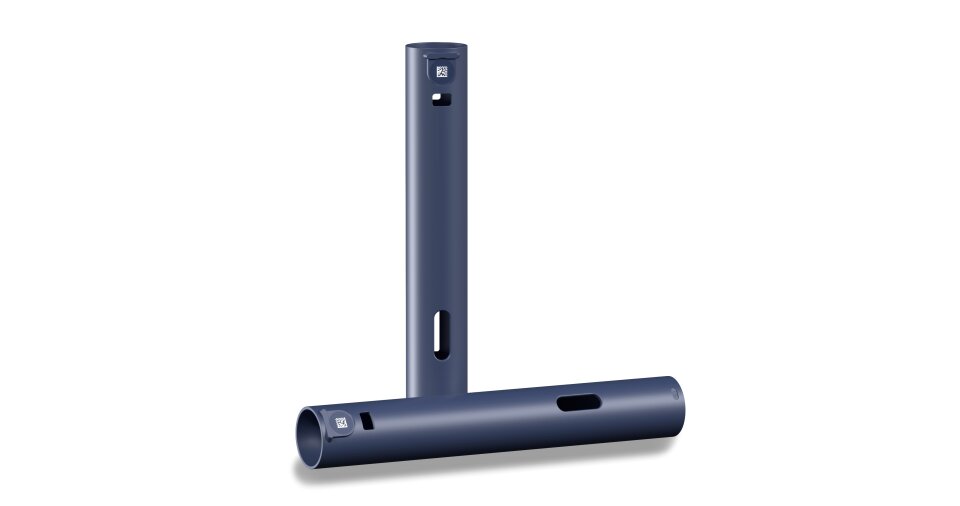
Geometric marking without additives
Matriq, a spin-off from the University of Applied Sciences of Eastern Switzerland, developed the marking technology under the name DM-qode. Unlike laser marking, the method does not depend on colour contrast. Instead, the code consists of a geometric structure formed during injection moulding. It can therefore be used with components in different colours and materials, including black or transparent plastics and grades with a high filler content.
The process leaves the chemical structure of the original material unchanged. It does not remove material and does not thermally affect the part surface, which is relevant for safety-critical or mechanically loaded components. According to Matriq, the method uses approximately 20 times less energy than conventional laser systems. It also requires no additives or consumables such as RFID tags or in-mould labels.
No particulate is produced during marking, making the process compatible with cleanroom production. The technology can currently be used at mould temperatures of up to 100 degrees Celsius. A cooling solution for the mould insert is under development.